The research will investigate how the chemical composition of post-fire soils is linked with soil water repellency and reflectance
Reno, Nev. (September 25, 2025) – A significant knowledge gap exists in understanding the post-fire soil chemical processes that lead to soil water repellency and, consequently, increase the risk of post-fire hazards such as floods and landslides. To help address this, DRI Associate Research Professor Vera Samburova and Postdoctoral Researcher Yan Wen were recently awarded a National Science Foundation grant to study the chemistry of post-fire soil water repellency. The research will address this knowledge gap by identifying the dominant organic chemical compounds and functional groups that cause post-fire soil water repellency. The three-year project began this month.
“We know that after fires, soil becomes very water-repellent (or hydrophobic),” said PI Samburova. “We often see the news reports of mudslides or debris flows after rain especially in areas with recent fire scars. When soil is exposed to high temperatures, certain compounds can create a repellent layer that prevents water from soaking in. In this research, we will study the chemistry of the post-fire soils and identify which compounds contribute to the formation of this water repellency. Our findings will help predict and reduce the harmful impacts of wildfires.”
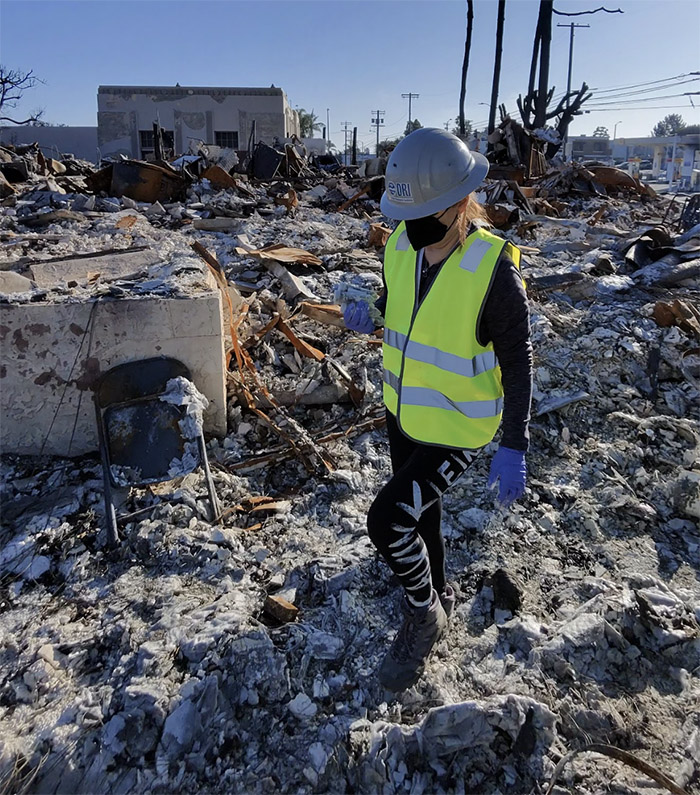
Pre- and post-wildfire soil samples will be collected from different ecosystem areas (sagebrush, pine forest, etc.), and compared with a unique set of samples collected by Dr. Samburova after the recent wildland-urban interface fires in Los Angeles.

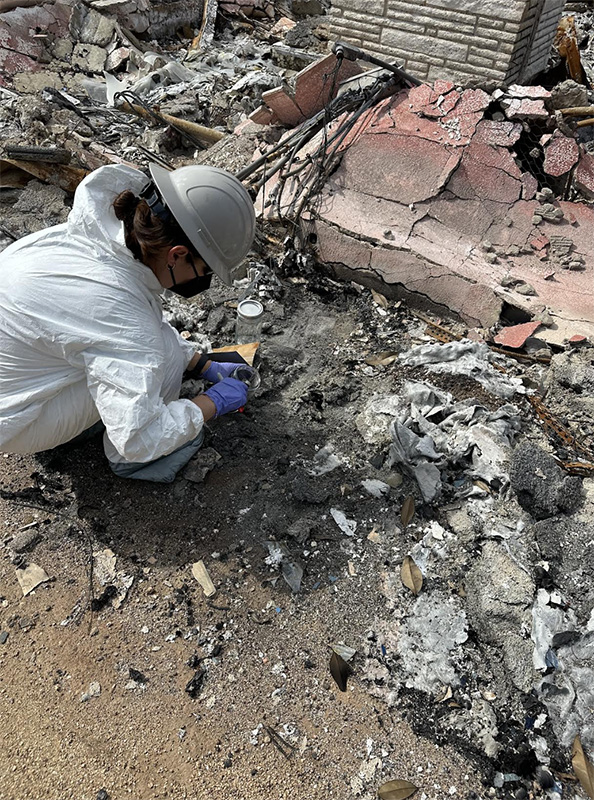
“Through this research, we will provide fundamental data on the chemical composition of post-fire soils with a focus on soil water repellency and reflectance,” said co-PI Wen. “The experiments and analytical techniques will provide transformative insights into post-fire soil chemistry and its implications for post-fire soil assessments, which directly relate to mitigation efforts for floods and landslides.”
The research findings will help to predict, model, and mitigate fire impacts on communities and the environment in Nevada, neighboring states, and the western U.S.
“We look forward to sharing the results of this project with local and regional land- and fire-management agencies and other stakeholders, as well as with users of remote sensing techniques for post-fire soil assessments,” said Samburova.
# # #
More information: NSF program: Division of Chemistry: Disciplinary Research Programs (CHE-DRP), Environmental Chemical Sciences https://www.nsf.gov/funding/opportunities/ecs-environmental-chemical-sciences
About DRI
We are Nevada’s non-profit research institute, founded in 1959 to empower experts to focus on science that matters. We work with communities across the state — and the world — to address their most pressing scientific questions. We’re proud that our scientists continuously produce solutions that better human and environmental health.
Scientists at DRI are encouraged to follow their research interests across the traditional boundaries of scientific fields, collaborating across DRI and with scientists worldwide. All faculty support their own research through grants, bringing in nearly $5 to the Nevada economy for every $1 of state funds received. With more than 600 scientists, engineers, students, and staff across our Reno and Las Vegas campuses, we conducted more than $52 million in sponsored research focused on improving peoples’ lives in 2024 alone.
At DRI, science isn’t merely academic — it’s the key to future-proofing our communities and building a better world. For more information, please visit www.dri.edu.