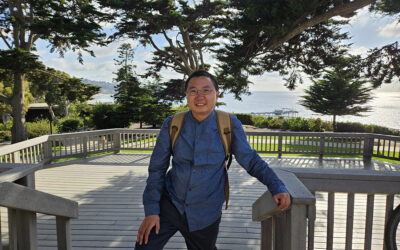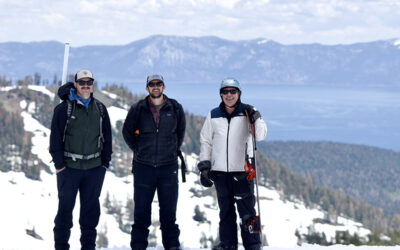
Prakash Gautam, Ph.D., is an Assistant Research Professor in the Division of Atmospheric Sciences and the Director of DRI’s Optics Lab: “Gautam Laboratory for Advanced Aerosol Dynamics and Light Scattering Research.” He has been with DRI since August 1, 2022, when he first joined as a Postdoctoral Researcher. Gautam also serves as Graduate Faculty in the Physics and Atmospheric Sciences departments at the University of Nevada, Reno (UNR), where he contributes graduate teaching, mentorship, and research collaboration. His work seeks to understand how atmospheric particles interact with light in order to better understand atmospheric components. This knowledge supports the development of advanced optical methods for detecting and monitoring aerosols such as dust, smoke, secondary organic aerosols, pollen, and other biological particles in the atmosphere.
Gautam was born and raised in the Surkhet District in the western part of Nepal and moved to the U.S. in 2016 to pursue a Ph.D. in Physics.
In the following interview, Gautam shares his dual passions for physics and tennis and offers insight on creating a successful career in science.
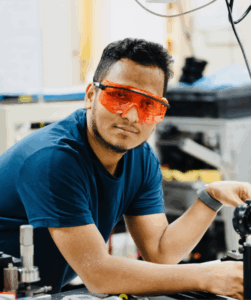
DRI: Tell us about your background and what brought you to DRI.
Gautam: I received my Ph.D. in Physics from Kansas State University in 2022, where my research focused on electromagnetic and light scattering and laser physics, with an emphasis on applying these principles to study free-flowing and suspended aerosol systems. My doctoral work involved developing and using advanced laser-based optical setups to investigate how particles interact with light, laying the foundation for my current research in aerosol optics, instrument development, and light–particle interaction physics. Before coming to the United States, I completed both my Master’s and Bachelor’s degrees in Physics, with a minor in Mathematics, at Tribhuvan University in Nepal.
Toward the end of my Ph.D., I was eager to broaden my research expertise and take the next step toward becoming an independent scientist. While exploring postdoctoral opportunities, I received several offers including one from the Division of Engineering and Applied Science at the California Institute of Technology with Prof. Richard Flagan. However, I ultimately chose to join DRI as it offered a distinctive environment that promotes both scientific independence and career growth. Chatting with President Kumud Acharya helped seal the deal. At DRI, I saw the opportunity to not only advance my research in optical and laser physics but also to apply that expertise to understanding the optical and microphysical properties of aerosol particles. This interdisciplinary focus perfectly aligns with my long-term goal of developing advanced optical instrumentation and analytical approaches to address complex challenges in optical and aerosol physics.
DRI: What are some of the big research questions that you’re interested in?
Gautam: Our group explores how tiny aerosol particles scatter and absorb light. My goal is to develop better optical techniques for characterizing these particles and to advance remote sensing and real-time (in-situ) monitoring technologies that can measure them without physical contact. I’m particularly interested in questions such as:
1) How can we better link a particle’s shape, size, and composition to the way it scatters and absorbs light?
2) Why do current satellite and ground-based instruments struggle to detect and measure aerosols precisely, and how can we reduce that uncertainty?
3) Can we design more advanced and affordable optical sensors that provide real-time, high-resolution data for remote sensing and defense applications?
4) How do particles evolve from small clusters to complex aggregates and how does that transformation influence their optical and physical properties?
I’m also exploring ways to integrate holography, multi-angle static and dynamic light scattering, and artificial intelligence to visualize and characterize particles in three dimensions. Ultimately, my goal is to bridge advanced optical and laser science with practical, field-deployable technologies that improve our ability to detect, characterize, and monitor aerosol particles. These innovations have important implications not only for environmental research and climate studies, but also for defense and security applications, where accurate, real-time aerosol characterization is critical. One example is developing technology that can detect the pollen present in the air in order to improve allergy warnings.
DRI: How are you working to address these research challenges?
Gautam: To answer these questions, my group develops and applies a range of advanced optical techniques to study how particles interact with light under different conditions. We employ static and dynamic multi-angle light scattering, including a custom built, angularly resolved light-scattering (ARLS) system that measures scattered light from nearly 0° to 180°, providing detailed insights into particle size, shape, and compositional (complex refractive index) properties. We also use digital holography to capture three-dimensional images of particles and fluorescence and optical trapping (OT) methods to isolate and study individual particles in real time. To handle the large, complex datasets these techniques produce, we integrate artificial intelligence (AI) and machine learning (ML) for automated analysis and pattern recognition. By combining these complementary approaches, we aim to develop next-generation optical instruments that advance both fundamental aerosol science and practical monitoring technologies for environmental, remote sensing, and defense security applications.
DRI: What are some projects that you’re working on now?
Gautam: My current projects focus on understanding how aerosol particles, especially mineral dust and bioaerosols, interact with light using static and dynamic light scattering and holographic techniques. We are developing state-of-the-art multi-angle light scattering and holography-based instruments to precisely measure particle size, shape, and complex refractive index (identification of particle composition), improving aerosol monitoring and remote sensing capabilities. These efforts connect fundamental aerosol physics with practical sensor development and commercialization through collaborative research and partnerships with small businesses. Our group is currently collaborating with small businesses like American Ecotech Ltd. and The Probitas Project Inc. These projects are supported by active grants totaling » $4 million from the NSF, DOE, NASA, and DRI’s internal funding programs.
DRI: What research are you most proud of?
Gautam: I am most proud of the angularly resolved light-scattering setup I developed during my Ph.D. program, which was later published and has since become the foundation for several research projects and proposals. Building on that work, we have expanded the system to measure the wide-angle optical properties of diverse aerosol particles and to develop new instruments for coarse-mode particle size characterization by integrating multiple optical techniques. The original setup from my Ph.D. served as the conceptual foundation for ongoing instrument development, and since then, I have designed a more advanced version featuring high-sensitive detectors and improved laser sources for greater precision and broader measurement capabilities.
DRI: Can you tell us about your research group and what you’re building at DRI?
Gautam: I established the “Gautam Laboratory for Advanced Aerosol Dynamics and Light Scattering Research”, also known as DRI’s Optics Lab, and it’s growing quickly! Our group currently has four senior undergraduates and one Ph.D. student (Andrew Ramirez), with another Ph.D. student and a postdoctoral researcher joining soon.
Our lab uses state-of-the-art optical systems based on novel optical schemes to investigate the scattering and absorption behavior of aerosols and colloidal particles across the submicron to super-micron size range. We focus on both individual particles and ensembles, collaborating with others at DRI including Vera Samburova, Nic Beres, Hans Moosmüller, as well as UNR faculty like Patrick Arnott and Neil Lareau. We also work with researchers at University of Wyoming, University of Oklahoma, NASA’s Langley Research Center, and small businesses. Our group’s long-term goal is to establish DRI’s Optics Lab (Gautam Laboratory) as a globally recognized facility for aerosol optics research, built on innovation, teamwork, and scientific excellence.
DRI: What excites you most about leading your own projects and research group?
Gautam: Absolutely! It’s an amazing feeling to finally work independently to lead projects that truly excite me instead of working under a supervisor’s direction. It’s both rewarding and challenging. Now, instead of knocking on my advisor’s door for help, students come to me with their questions, and that’s a wonderful shift. Seeing my name on the lab door and walking in to do science every day is both humbling and motivating. I’m also fully aware of the challenges that come with this role, and I’m working hard to tackle them as I continue growing in this new phase of my career.
DRI: Did you want to be a scientist when you were a kid?
Gautam: No, not at all! I just went with the flow. Honestly, I didn’t even want to go to school at first, my mother convinced me by promising to buy me a bicycle and a few other small things. But as I got older, I started to really enjoy fundamental science and mathematics, and one thing led to another, here I am today. I never imagined I’d be supervising graduate students and postdocs this early in my career. Now, I don’t just want to be a scientist, I want to be a great one! Let’s see how the journey unfolds.
DRI: What do you want your DRI colleagues to know about you?
Gautam: People often think I’m serious when they first meet me, but give it a little time and you’ll find I love to joke around and really enjoy good conversations and teamwork.
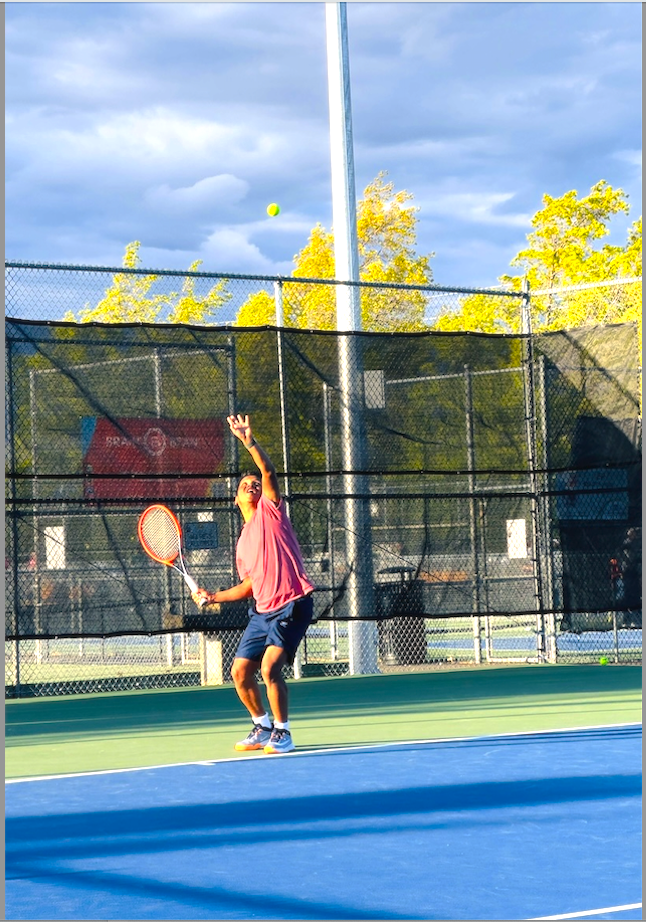
DRI: What do you like to do outside of work?
Gautam: I used to play soccer, but these days tennis has become my main sport. I play almost every day — whenever I get the chance. When I’m not on the court, I love watching tennis, cricket, and soccer matches for hours (almost like it’s my second job). Recently, our team won the Reno Tennis 3.5 level competition and advanced to the sectional tournament in Sacramento, though we didn’t win there. Outside of sports, I have a keen interest in politics and enjoy listening to talk shows and political discussions, something most of my friends don’t know about me.
DRI: Is there anything else that you want to share?
Gautam: I’d like to share a message with young scientists and early-career researchers, including myself: There are no fixed rules for success. Think independently, stay curious, and don’t be afraid to take bold and unconventional paths. If the right opportunity doesn’t exist, create it. Sometimes the best path forward is the one you build yourself.