Experts came together for the second AWE+ conference to tackle one of the West’s biggest challenges.
Last year saw DRI’s inaugural global initiative aimed at advancing community resilience and adaptability in the face of rapid global change – AWE+, for an Adaptable World Environment. The event brought together hundreds of scientific experts, policymakers, resource managers, and other stakeholders to discuss ways to strengthen our communities against the growing threat of wildfires. To maintain momentum on the topic and continue building relationships that advance resilience, DRI’s 2025 AWE+ event sought to build on these conversations, again focusing on wildfire and bringing experts together from across the nation. The goals of the October 16, 2025 event included:
- Highlighting and prompting the continuing and urgent need for community, regional, and state leadership in taking action to strengthen our communities to mitigate inevitable catastrophes that are compounded by changes in climate, land use, and population.
- Promoting interdisciplinary, cross-sector collaboration as essential in strengthening the resolve for tough decision making on consequential impacts and challenges to achieve meaningful progress.
Conversations about the role of wildfire risk in our communities were heavily weighted with the memory of the year’s devastating Los Angeles fires. January’s Palisades and Eaton Fires, which turned into urban conflagrations that decimated entire neighborhoods, claimed at least 31 lives. This number doesn’t account for the broader impacts of the burns and their air quality impacts, however, with recent research from Boston University estimating that at least 440 deaths can be attributed to the fires. The fact that these blazes occurred in the middle of winter underscored how wildfires are growing not only in size and intensity, but across time.
“Wildfires are now endemic across the West — there’s no wildfire season anymore,” said Sean McKenna, Director of DRI’s Division of Hydrologic Sciences. “The other thing I’ve come to realize is that we used to think of fires as discrete events, like an earthquake. But fires aren’t a discrete event followed sometime in the future by another one. It’s really this continuum — this cycle of fire and the landscape changing.”
Wildfires are a lived experience for many in the West, and the event attendees were not the exception. Naomi Duerr, Reno City Council member, told a personal story about living through Reno’s 2012 Caughlin Ranch Fire. She recalled how the fire quickly jumped neighborhoods and reached her street, a common theme during wind-driven wildfires. When she asked the audience whether anyone had ever been evacuated or lost their home insurance due to wildfire risk, dozens of people raised their hands. The harsh reality proved that those in attendance do not consider wildfire resilience to be merely an academic interest, but rather approach it from the perspective of wanting to protect their own homes and those of their friends and family.
Home Ownership, Insurance, and Personal Responsibility
A topic that has become an increasingly important part of discussions about wildfire risk in the West is the growing threat of losing one’s home insurance. More and more insurance companies are exiting regions they consider high-risk, like California, and others have stopped writing new policies.
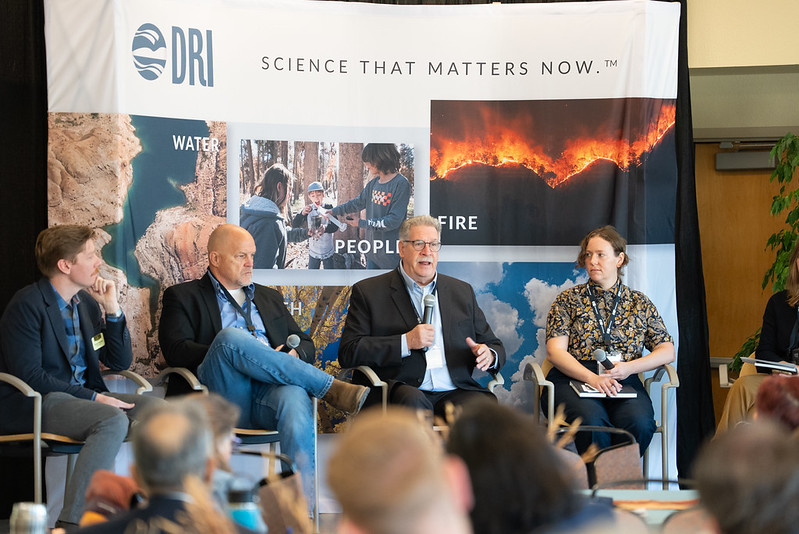
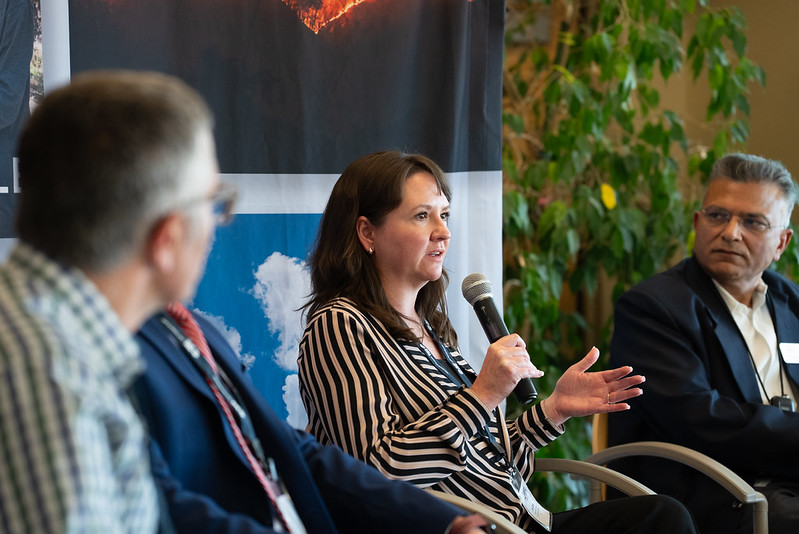
Panelist David Shew, a wildfire resilience consultant, addressed this issue from the perspective of living and working in Napa County, where he served as the Fire Administrator for two years.
“I see the pendulum beginning to swing in the insurance industry to where there are companies looking at the big red fire hazard zones on the maps and instead of saying ‘That’s too dangerous, here’s your non-renewal notice,’ and all those things that we’re used to seeing, they’re looking at those red zones and saying, ‘Okay, you live in a dangerous area — so what are you doing about it?,’” Shew said.
“They’re beginning to recognize and reward the people who are taking the steps… and saying we can not only reduce your rates, but increase your policy coverage because of the work you’ve done.”
Homeowner incentives like these can help communities become more proactive about protecting their own properties by addressing high-risk landscaping, for example.
These types of shifts in the way that we view personal responsibility could make a huge difference in creating a community-centered approach to wildfire risk. The public utilities clearly have a huge role to play in fuels reduction, equipment upgrades, and monitoring, and are spending around $9 billion each year on these upgrades. That contrasts with the approximate $500 million of state investment toward the same goal.
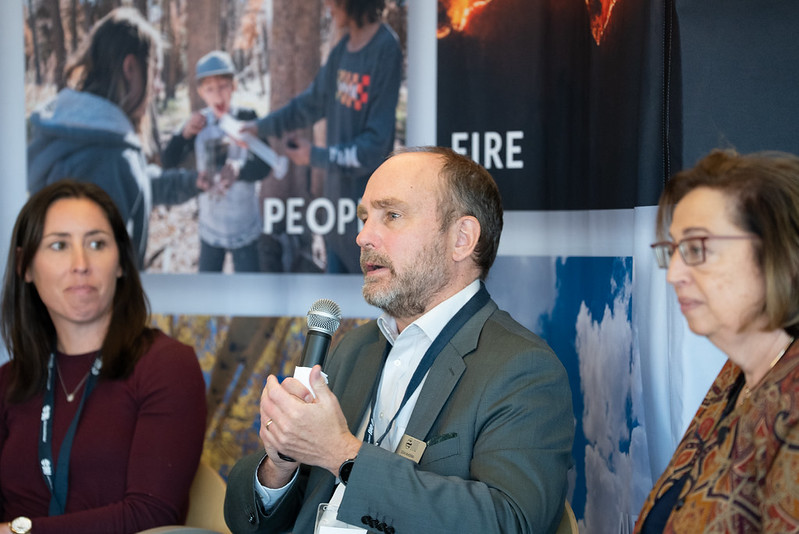
“I think the utilities have made a huge amount of progress,” said Michael Wara, Director of Climate & Energy Policy Program at Stanford University. “I sleep much better at night as a PG&E customer than I did in 2017-2019, because of the investments that have been made on the poles, vegetation management, and especially operational changes about managing through these dangerous wind events. Where I see that we need to make much more progress is in people’s backyards and their houses. And that is a social problem – it’s hard.”
The types of upgrades that communities need to make vary from region to region, with panelists pointing out that new, wildfire-conscious building codes would help in areas like Reno, where a lot of new homes are being built. In California, however, new homes are difficult to build, making retrofitting of older homes an important tool for addressing wildfire risk.
The Human Element
A recurring theme throughout the discussions was the difficult task of addressing thorny social issues and human behavior. When trying to encourage personal behavioral change, like reimagining the way that those living in wildfire risk areas landscape their yards, scientists need to integrate social science concepts to better reach community members.
“We all need to be thinking about how can we do science to understand how community cohesion is created and community implementation occurs, but also just talk to people like they’re people, listen to them, and think about what they care about, not what we care about,” Wara said.
This means addressing their concerns beyond wildfire risk when helping them create more resilient homes, like how to ensure that their yards still work for their families and daily lives. Scientists and policymakers need to acknowledge that everyone is balancing needs and that fire risk isn’t their first priority.
Being better listeners also applies when trying to address questions of human health as it relates to wildfire smoke exposure. Panelist Dr. Nicholas Nassikas, Assistant Professor of Medicine at Harvard Medical School, works on lung diseases and in the ICU in Boston. With the east coast receiving more and more smoke from large Western fires, his patients have been asking him about how it may be impacting their asthma. When smoky days coincide with extreme heat, it becomes even more difficult to help patients protect themselves, as many don’t have central air conditioning in their homes. This creates a choice between staying indoors to avoid smoke exposure or opening the windows to help cool down their homes. Medical experts are still trying to understand what long term exposure to wildfire smoke means for human health, Dr. Nassikas noted.
Wrapping up the conference, Reno City Council Member Duerr commented that all of the research needs and progress mentioned require resources to accomplish, and that all levels of government in Nevada are struggling financially. “We’re extremely lucky to have DRI bringing in external funds to address these issues,” she said.
For more information about how DRI researchers are identifying solutions on this topic, read What We Know About Wildfire Risk and Prevention. To see the full agenda and speaker list for AWE+ 2025, visit https://www-dev.dri.edu/awe2025-agenda/.
——-
To learn more about supporting wildfire initiatives and other solutions-oriented science at DRI, please contact Kristin Burgarello, Director of Advancement, at kristin.burgarello@www-dev.dri.edu or (775) 673-7386.