Kelly Loria, Ph.D., is a Postdoctoral Researcher and stream ecologist who joined DRI in July 2025. She is working with Monica Arienzo, Brittany Kruger, and Mark Hausner to study the water quality impacts of the 2024 Davis Fire in southern Reno’s Washoe Lake and surrounding streams.
Loria grew up in the San Francisco Bay Area and completed her undergraduate degree at the University of Colorado, Boulder. Shortly before joining DRI, she wrapped up her Ph.D. at the University of Nevada, Reno (UNR), where she worked in Joanna Blaszczak’s aquatic ecosystem lab. In the following interview, Loria shares her passion for the ecology of western mountains and increasing our knowledge of Nevada landscapes.
DRI: Tell us about your background and what brought you to DRI.
Loria: My background is in mountain ecosystem ecology. I used to work with the Niwot Ridge Long Term Ecological Research Program that’s out of Boulder, Colorado, where I was the limnology program manager in the Green Lakes Valley of Colorado’s Front Range. It’s this series of alpine lake chains that serve about 40% of the city’s watershed, and it’s under city management. Because it’s a private watershed, they really limit human traffic into the area. This means most of the changes we’re seeing are coming from climatological or atmospheric deposition alone, because there’s really no footprint of humans coming in and manipulating it. Unlike the sister system that’s a few drainages north in Rocky Mountain National Park, which has so much tourism that there’s some evidence that humans and the waste they bring in might be impacting some of the nitrogen dynamics in some of those really serene, beautiful alpine lakes. I’m broadly interested in these direct and indirect ways that people are interacting with landscapes, and how those can relate to different tipping points for lakes and stream ecosystems. Winter is this awesome phenomenon where a lot of the surface water dynamics happen with snowpack. The way in which the snowpack forms and then melts kind of sets off this whole aquatic climatological system that can either facilitate this larger window of productivity or potentially weird mixing dynamics due to snowpack, lake ice cover, and runoff patterns. I’m broadly interested in mountain ecosystems and the way that we have these really big boom, bust winter cycles within them.
DRI: What did your Ph.D. dissertation focus on?
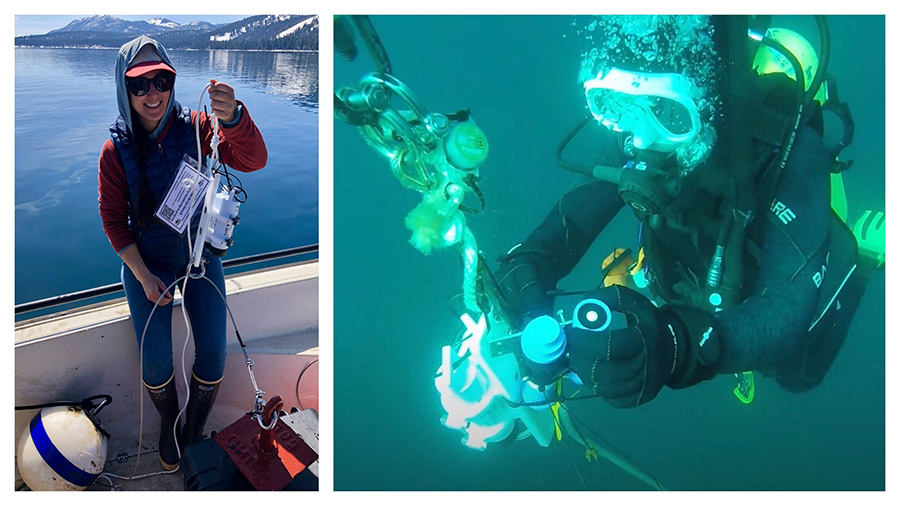
Loria: I was working with Joanna Blaszczak in her aquatic ecosystem lab at UNR. Most of my dissertation research focused on Lake Tahoe and the near shore of the lake, where we looked at how variation in the shoreline might be related to different algal productivity and carbon cycling dynamics. The lake is really renowned for its clarity, and streams could be transporting suspended solids, nutrients, and other things that might facilitate algal growth. But it’s a mountain system, so sometimes the flow is so high that these streams may actually be suppressing algal growth by causing all the rocks and things in the near shore to tumble down and cause a physical erosion or scouring mechanism.
DRI: How did you originally become interested in stream ecology?
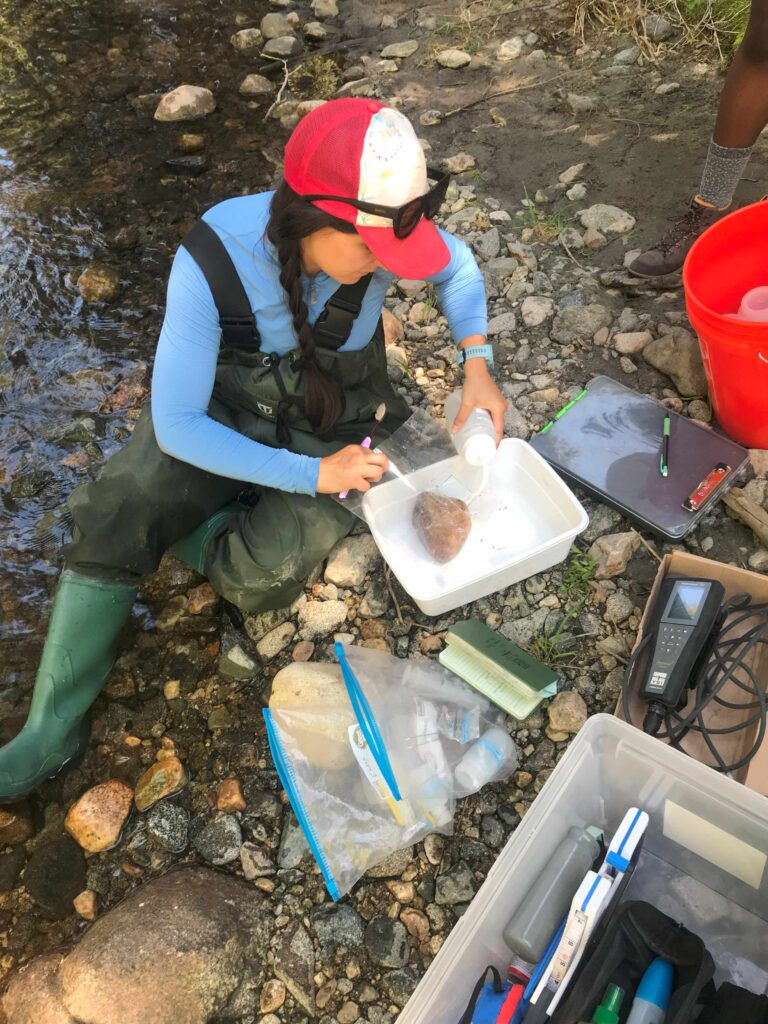
Loria: I thought I wanted to be a marine biologist, and my first research opportunity involved looking at plankton samples from lakes underneath a microscope. I thought that would tie into marine systems, but I became entranced with freshwater dynamics. Especially high elevation systems that tend to have highly specialized and yet relatively simple food webs, and yet the simple mechanisms within that food web can lead to complex ecosystem interactions that reflect larger climatological signals. I realized that it was a cool puzzle to be solving, and it’s not a bad life hiking around lakes and streams. They’re beautiful ecosystems to work in.
DRI: What are some of the big research questions you’re interested in?
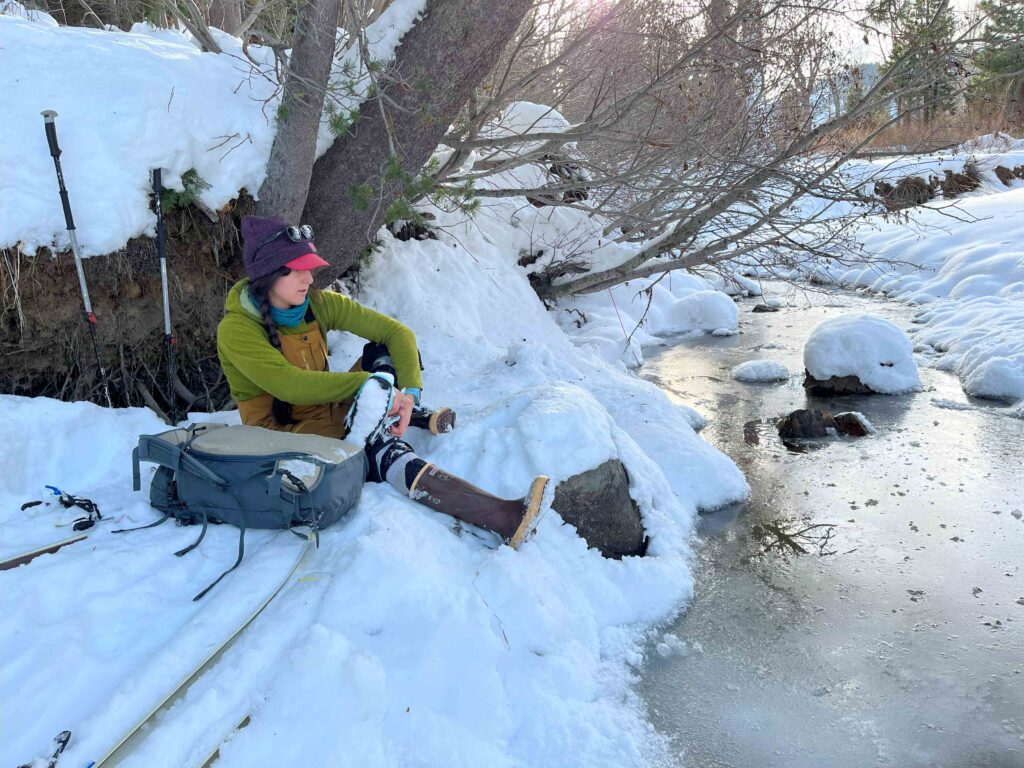
Loria: I’m really interested in characterizing the relative importance of each season within both lakes and streams. So, examining how ice formation and snowpack formation have these incredibly strong signals that set up the physics of how biotic communities in freshwater ecosystems might function. I’d like to learn more about ecological memory. For example, what are the long-term impacts of sustained drought, or can we see a continuous effect of storm intensity throughout the growing season?
DRI: What projects are you working on now?
Loria: My main project right now is thinking about some of these biogeochemical responses. We’re looking at how different materials are moving into the stream channel and Washoe Lake following the Davis Fire, where we have a few different stream networks that span a nice gradient in stream flow size and burn severity. We’re thinking about how dynamics around storm events, as well as continued recovery time, might relate to different nutrients being exported or assimilated by the streams. We’re also looking at metals and other important ions that folks are concerned about from a water quality standpoint.
DRI: What research are you most proud of?
Loria: I’m really proud of accumulating data sets. Much of my dissertation assembled these long daily time series of dissolved oxygen, specific conductance, and temperature from the near shore of Lake Tahoe and nearby mountain streams. I’m also proud of contributing to a data set for an east shore stream in Nevada. Nevada streams are somewhat under monitored, and we found higher concentrations of dissolved nitrogen and other ions relative to some of the streams on the California side of the Tahoe Basin. In general, I think contributing to any freshwater data set in the state of Nevada is really powerful and important. We don’t have many of those relative to other states, and it’s a pretty unique basin range ecosystem that I think merits more attention.
DRI: What do you want your DRI colleagues to know about you?
Loria: I’m excited to keep bringing an ecological perspective to some of the climatological, geochemical, and hydrological expertise that’s already here. I’m excited to learn from others, because I think there’s just so much expertise here to be gained as an early career researcher. I’m also very interested in collaborating on Nevada water issues and learning from the vast expertise across all the different spheres at DRI.
DRI: What do you like to do when you’re not working?
Loria: I like riding my bike — that’s my favorite thing to do, and this is such a great area for it. We have countless trails that span awesome deserts and mountain peaks. It’s absolutely one of the best places to be if you love mountain biking.
DRI: If you could recommend one book to your colleagues, what would it be?
Loria: As a water scientist in the west, I feel I should say Cadillac Desert, but This Old Drift by Namwali Serpell was one of those novels that really sucks you in and still has some climate and water themes to move the plot forward.
DRI: Is there anything else you want your colleagues to know about you?
Loria: Just that I’m interested in collaborating in any way, shape and form. I’m grateful to be here, and I’m proud to get to join DRI for as long as I get the opportunity to.