Reno, Nev. & South Lake Tahoe, Cal. (July 20, 2020) – Last year, Desert Research Institute (DRI) and the League to Save Lake Tahoe detected microplastics in Lake Tahoe for the first time ever, many of which were microfibers. This discovery revealed that microplastic pollution is not just present in oceans, but also in mountains and lakes, including highly protected areas like Lake Tahoe.
Now, two DRI scientists aim to identify the source of these microfibers, with help from the League to Save Lake Tahoe’s citizen scientists and other volunteers from the Tahoe Basin. In a new study, volunteers from around the Tahoe region are installing specially made lint-catchers on the vents of their clothes dryers to assess whether dryers are releasing these tiny fibers into the environment.
“Several studies have been done on the washing process and how that can input microplastics into our waterways, but only a few studies have look at the drying process as a source of microplastics,” said Monica Arienzo, Ph.D., Assistant Research Professor of Hydrology at DRI. “That got us thinking about studying the drying process as a source of microplastics to the air.”
Working in collaboration with Meghan Collins, M.S., DRI’s Education Program Manager, the researchers developed a design for a lint-catcher that fits on the outside of a dryer vent. They then worked with the League to Save Lake Tahoe to create a plan for engaging citizen scientists in the study, tapping into the League’s network of dedicated Pipe Keepers and other volunteer groups.
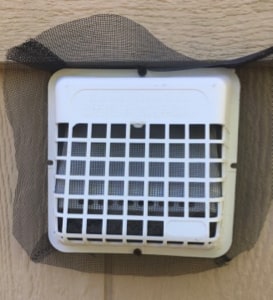
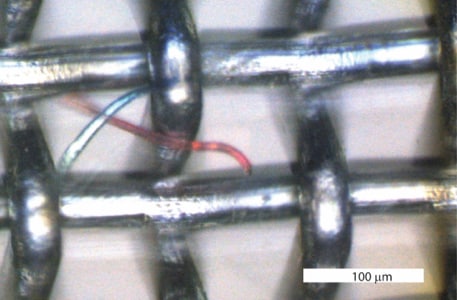
Photo caption: (Above, left) Using a custom-made lint catcher, citizen scientist volunteers in the Tahoe Basin will help collect data for a new study on dryer lint. (Above, right) Closeup image of microfibers found in snow from Sierra Nevada. Fibers such as these are potentially emitted from the drying process. Credit: DRI.
Citizen scientists, including those who are brand new to volunteer data collection and research, can contribute to the study in one of two ways: 1) By sharing their drying habits with the researchers (how many loads they dry, dryer settings, and other details) for a month via the Citizen Science Tahoe app, or 2) By installing a lint catcher on the dryer vent on the outside of their home and sharing their drying habits.
The study will run from July 12 until August 7, at which time participants will mail back a custom-made fiberglass mesh net that sits inside the dryer vent cover, and researchers will analyze the contents.
“We will use all of this information to understand the connection between synthetic clothes, dryers, and microfiber emissions into the environment,” Collins said. “We are also hoping that our lint catcher design will provide an easy solution for helping individuals to reduce their ‘microplastic footprint’. We’re excited to see what citizen scientists think about this solution.”
While litter of all types poses a threat to the Lake Tahoe environment, plastic trash is consistently the most-gathered class of litter items at Keep Tahoe Blue beach and community cleanups. Plastic trash may breakdown to create microplastic pollution, which can end up in the Lake.
“Our hope is that this and future studies will narrow in on the sources of microplastic pollution at Tahoe,” noted Jesse Patterson, Chief Strategy Officer at the League to Save Lake Tahoe. “Combined with litter data gathered by Keep Tahoe Blue volunteers, we hope to convert the findings into solutions to the pollution problem facing our Lake. This is only possible through the partnership of research experts at DRI and passionate citizen scientists.”
This project is made possible in part by support from the REI Co-op. For more information on how to participate, please visit: https://t.e2ma.net/webview/d5jb6e/5737d228884cbb56c17378bdf8decceb
###
About the Desert Research Institute
The Desert Research Institute (DRI) is a recognized world leader in basic and applied interdisciplinary research. Committed to scientific excellence and integrity, DRI faculty, students, and staff have developed scientific knowledge and innovative technologies in research projects around the globe. Since 1959, DRI’s research has advanced scientific knowledge, supported Nevada’s diversifying economy, provided science-based educational opportunities, and informed policy makers, business leaders, and community members. With campuses in Reno and Las Vegas, DRI serves as the non-profit research arm of the Nevada System of Higher Education. For more information, please visit www.dri.edu.
Media Contact:
Justin Broglio, Communications Manager
Desert Research Institute
775.762.8320
justin.broglio@www-dev.dri.edu
About the League to Save Lake Tahoe
The League to Save Lake Tahoe, also known by the slogan “Keep Tahoe Blue,” is Tahoe’s oldest and largest nonprofit environmental advocacy organization. The League is dedicated to community engagement and education, and collaborating to find solutions to Tahoe’s environmental challenges. Through the League’s main campaigns, its expert staff and dedicated volunteers A.C.T. to Keep Tahoe Blue: we Advance restoration, Combat pollution and Tackle invasive species. Learn more at keeptahoeblue.org.
Media Contact:
Chris Joseph, Communications Manager
League to Save Lake Tahoe
805.722.5646
cjoseph@keeptahoeblue.org